Solution · Workforce Planner
Your occupancy, your events and your covers all sit in different systems. Right now, pulling that together into one roster still means combining gut feel with data hunting. Our AI does it in a blink: it aggregates every demand signal across your hotel and turns it into a draft roster, you confirm. We're not another scheduling tool, we're the layer that drives your planning and keeps your labour cost in a healthy ratio to revenue.

Where the schedule loses time
Demand estimated on gut feel, not on real occupancy
Data scattered across the booking system, calendar and chat
The schedule is outdated again before you’ve even published it
Three steps, one draft schedule that works.
From the signals that determine your busyness to a schedule where you stay in control.
Step 01
Step 02
Step 03
What creating the schedule looks like per department.
Each department draws on its own signals from different sources, but the principle stays the same.
HOUSEKEEPING
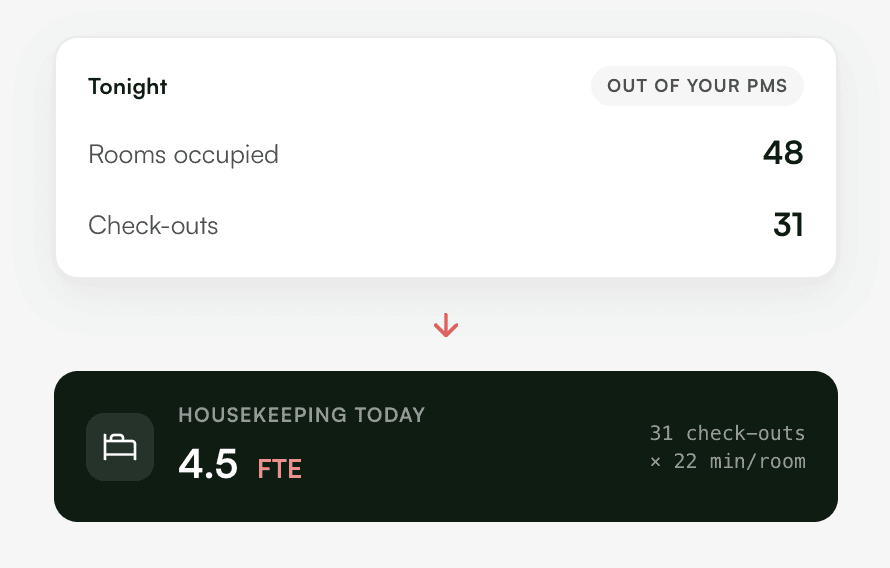
The roster follows tonight's staffing.
Before
Housekeeping is scheduled on gut feel and outdated data. Profitability leaks with every shift.
Now
Live occupancy sets the number of rooms, the type of clean and the minutes each one takes. Headcount is calculated from there. Your team is set up to deliver, and your labour cost stops leaking.

F&B
Staffing per half-day, not for the whole day.
Before
Breakfast, lunch, bar, dinner, and banqueting each run at their own busy times, but the schedule for the entire day is made by feel.
Now
Covers, reservations, and events feed the schedule for each part of the day, ensuring you are neither too short nor too full at the moments that matter.
FRONT OFFICE
From Excel to system, without retyping.
Before
Log into multiple systems, look up the data, type it into Excel, then retype it into your scheduling tool.
Now
Live data flows in via API. Your draft schedule is ready in seconds. Review it, adjust it, publish it in one click.

Five things that change.
What changes when your schedule starts with your busy schedule.
Weeks of work become hours.
The AI does the heavy lifting; you review and adjust.
Schedules based on workload.
Not by gut, but by the lineup and events that are actually coming up.
Costs immediately clear.
You see the personnel costs while you plan, not just afterwards.
One source instead of separate systems.
Occupancy, availability, and contracts come together.
You are in control.
Nothing goes to your team automatically. The concept is yours to adapt.
No standalone scheduling package. A layer that translates your workload into a schedule.
How the project runs
Read in the demand
We link the signals that determine your busyness: occupancy, events, patterns.
Generate the concept
AI creates a draft schedule based on your work standards, including insight into personnel costs.
Tweak & publish
You adjust wherever you want and publish in your own package.
FAQ
Here you’ll find answers to the most frequently asked questions.