Solution · AI Automation

Manual work out. AI in.

Manual work out. AI in.

Your foundation is solid and your systems work. But your team still spends hours a week retyping, checking and merging data. We automate those processes with smart flows and AI, inside the systems you already use.

Automation

Trigger

new input

AI

processes

Action

done

Your team is doing work
that a machine does better.

The problem, framed as a heading.

Typing data from one system to another. Performing the same check for the third time. Gathering information from three screens to send a single email. It is work that needs to be done, but no one misses it if it happens automatically.

And it piles up. Every hour your team spends on this is time that isn't going towards the work you hired them for. The brake isn't in your people or your systems. It lies in the steps in between.

Typing data from one system to another. Performing the same check for the third time. Gathering information from three screens to send a single email. It is work that needs to be done, but no one misses it if it happens automatically.

And it piles up. Every hour your team spends on this is time that isn't going towards the work you hired them for. The brake isn't in your people or your systems. It lies in the steps in between.

What’s slowing teams down

Re-typing the same data from one system into another

Running the same checks over and over by hand

Piecing together three screens just to send one email

Three steps, one working flow.

We start small, where the gain is immediately visible, and build out from there.

Step 01

Choose the process

Together we find the processes that cost the most time and lend themselves best to automation.

Step 02

Build & connect

We build the workflow and connect it to your systems. Where it makes sense, AI does the heavy lifting: reading, summarizing and classifying.

Step 03

Run & adjust

We let it run, check that it does the right things in practice, and adjust until the work flows the way it should.

What it looks like in practice.

Three processes where a flow with AI already takes over the manual work.

Example 01

Automating email handling.

Before

A customer sends a request and your team answers dozens of questions a day, all by hand. Most are simple, repeat questions that need no human judgment, yet they eat up a large part of the day.

Now

A flow with a language model runs right on the existing mailbox. Every incoming email is sorted automatically: known questions are answered, and the rest goes to the team with a summary. We start with an approval step and release it per category once the trust is there.

Example 02

Automating invoice checks.

Before

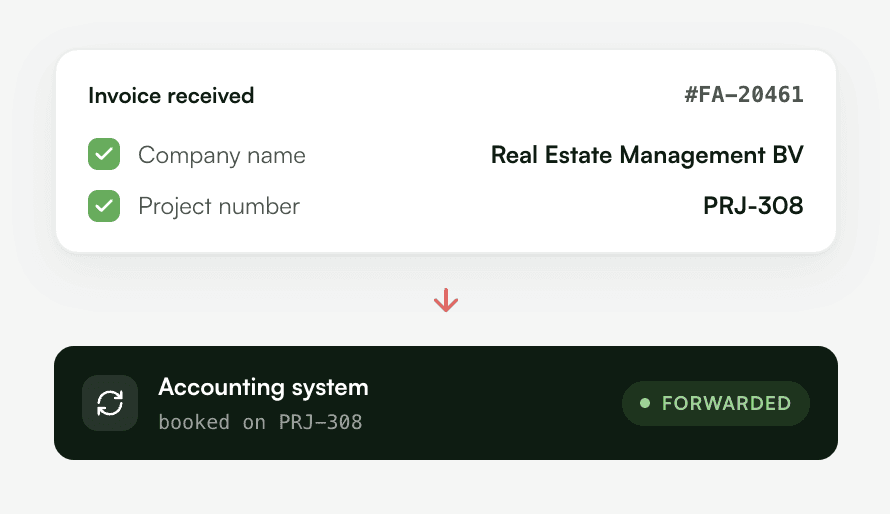
Invoices land in the bookkeeping mailbox and are checked one by one by hand for the right project number before they enter the accounting system. The mailbox fills up and the checking stays manual.

Now

The same light approach: a model on the existing mailbox. The invoice comes in, the model checks the project number and forwards it to the accounting system when it’s correct, or flags it with a note when something differs. Trusted suppliers pass through without a check.

Example 03

Automating on-site reporting.

Before

Specialists do their work on site, but the admin happens back at the desk. A manager visits several locations a day and is still updating files in the evening. Notes sit in a scribble or a stray message, case files run days behind, and half the week is lost to writing things up.

Now

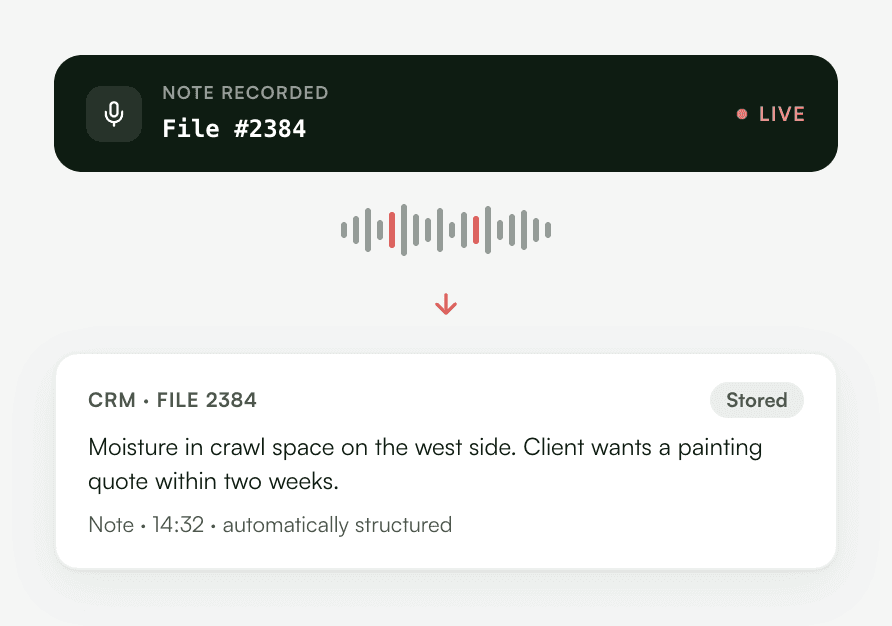
Between two visits the specialist records a voice note. AI transcribes it, recognizes the jargon, structures the text and files it in the right record in the CRM. Within minutes the information is in the system, structured and on time. No evening work, no files running behind.
Five things that change.

Shifts that stack up through the work week.

Hours back each week.

Work that used to be overtime now largely runs on its own.

Fewer mistakes.

A flow never forgets a step and never mistypes anything.

Shorter turnaround times.

What used to sit for days now happens instantly.

Your team on the right work.

People do what they’re good at, not the repetitive work no one misses.

It scales with you.

More volume doesn’t mean more manual work. The flow grows with you.

Not a loose tool.
An automation that
fits your process.

We don’t build automation for automation’s sake.

We don’t build automation for automation’s sake.

We look at your process first, choose what’s most valuable, and build it into the systems you already use.

No vendor lock-in, no black box.

It starts with discovery: sitting in, listening, mapping the process. Only then do we design and build — the whole chain, not just the fashionable part.

And we stay involved during rollout. A flow no one trusts yet doesn’t get used.

So we keep adjusting until it runs exactly the way it should.

We look at your process first, choose what’s most valuable, and build it into the systems you already use.

No vendor lock-in, no black box.

It starts with discovery: sitting in, listening, mapping the process. Only then do we design and build — the whole chain, not just the fashionable part.

And we stay involved during rollout. A flow no one trusts yet doesn’t get used.

So we keep adjusting until it runs exactly the way it should.

This is how the process goes

Choose process

We are looking for the process where the profit is immediately visible.

Build & connect

Flow and AI, linked to the systems you already use.

Pilot

Live in practice, with an approval step where necessary.

Expand

Does it work? Then we expand to the next process.

FAQ

Here are the answers to the most asked questions

What does it cost to automate business processes?

That depends on the process and systems involved. We start small with the process that pays off fastest.

What does it cost to automate business processes?

That depends on the process and systems involved. We start small with the process that pays off fastest.

What does it cost to automate business processes?

That depends on the process and systems involved. We start small with the process that pays off fastest.

Is AI automation the same as a tool like Zapier or Make?

Is AI automation the same as a tool like Zapier or Make?

Is AI automation the same as a tool like Zapier or Make?

Which process should we automate first?

Which process should we automate first?

Which process should we automate first?

Do you replace our existing systems?

Do you replace our existing systems?

Do you replace our existing systems?

What happens if the AI makes a mistake?

What happens if the AI makes a mistake?

What happens if the AI makes a mistake?

Ready to eliminate manual work?

A half-hour conversation is enough to see which process is best suited to start with. We listen, ask questions, and think aloud along.