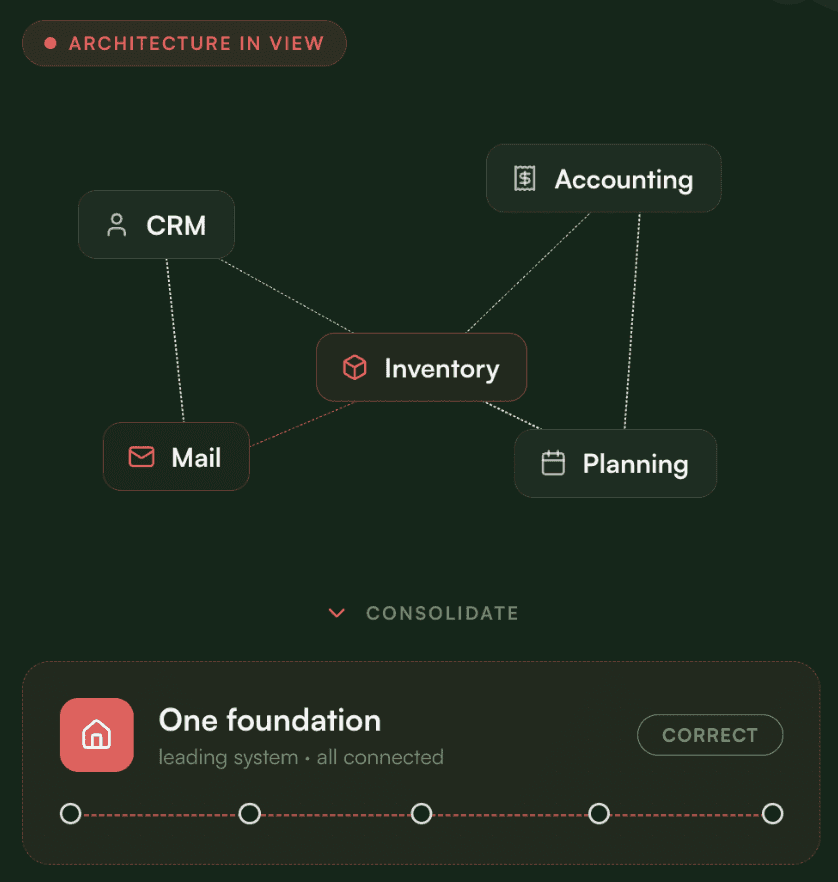
Where is your growth getting stuck?
Where growth gets stuck
The same customer data living in three separate systems
Half the process running on spreadsheets
Critical knowledge sitting with one or two people, not your systems
Three steps, one foundation.
From what stands now, to an architecture that fits and grows with the times.
Step 01
Mapping
We talk to the people who do the work, across all departments, and go through every process. From initial customer contact to invoicing.
Step 02
Blueprint
We translate that into a clear software architecture: which system leads, what connects to what, and where the gaps are.
Step 03
Build & implement
We guide the software selection, arrange the integrations, and carry out the implementation. Until it is up and running and your team is working with it.
How it looks in practice.
Two companies that put their foundations in order before building further.
Example 01
A system choice based on facts, not gut feeling.
FORMERLY
GP Elite, a motorsport organization with around 150 events per year, ran on a custom-built system that had reached its limits. What the system lacked was compensated for with Excel, PDFs, and knowledge in people’s heads: 460 manual data transfers per year. The decision to replace it had been postponed for years because no one knew for sure what the right choice was.
NOW
We mapped out ten years of operational complexity across seven departments, translated it into requirements, and evaluated all candidates against a single scoring matrix of fourteen criteria. One leading system, explicit integration, no new silos, and ownership of code and data contractually established. The delayed decision has been made, based on facts.

Example 02
From eight years of legacy to one integrated platform.
FORMERLY
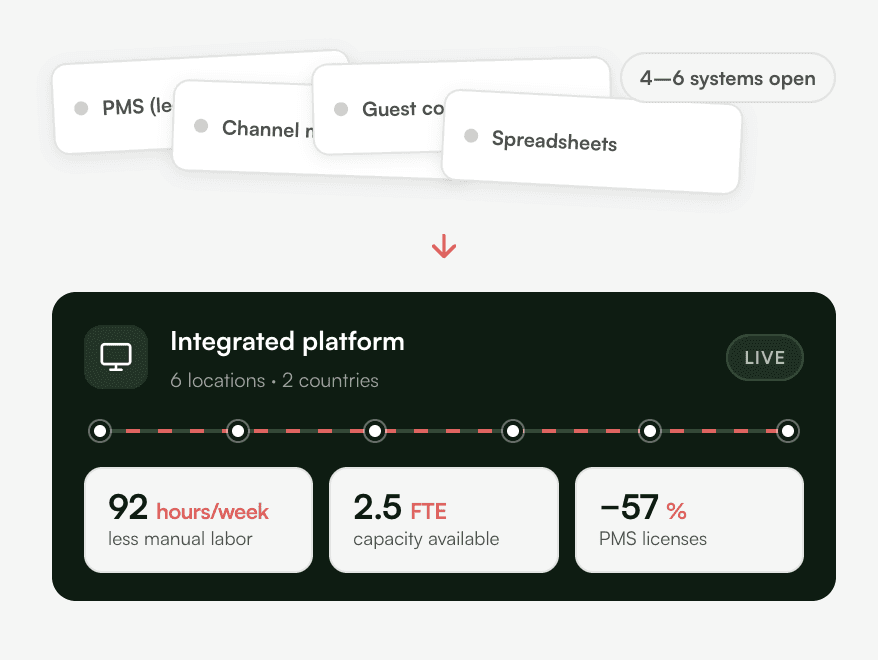
Pillows Hotels, with six locations in two countries, operated for over eight years on an outdated PMS with a stack that had been pieced together over the years. At the front desk, four to six systems were open simultaneously, guest communication ran through three separate tools, and group reservations were managed in spreadsheets. A previous attempt to resolve this had stalled.
NOW
In four phases, from discovery to go-live across all six locations over six months, we built a consolidated, integrated stack. The result: approximately 92 hours of manual work eliminated per week, over 4,200 hours saved annually, 2.5 FTE of capacity freed up, and significantly lower costs. A clean foundation on which every system communicates with every other, ready for AI.
Five things that are changing.
What a solid foundation changes throughout your entire company.
Overview instead of isolated islands.
One place where you know the data is correct, instead of five systems that contradict each other.
Systems that work together.
Information flows automatically between departments. No retyping, no exports, no duplicate entry.
No more double work.
Enter information once and it is available everywhere it is needed, without manual copying.
A choice that still makes sense in five years.
No more vendor lock-in, no supplier you are tied to. An architecture that grows with your business.
Ready for AI.
On a clean foundation, automation and AI can finally do their work. First the basics, then accelerate.
No standard package.
A foundation that suits
how you work.
This is how the process works
Discovery
Conversations across all departments, mapping the digital landscape.
Blueprint
A clear architecture: leading system, connections, the gaps identified.
Selection & implementation
Guide software selection, arrange integrations, carry out implementation.
Roll-out
Live, adjust, scale up. Until your team is actually working with it.
FAQ
Here are the answers to the most asked questions