What is a digital transformation strategy? (and what it gets you as an SME)
What is a digital transformation strategy and what does it get you as an SME? Best Byte explains plainly what it means, why it stalls, and which order works.

Mees Ruijgrok
Guidance
Reading time:
4 minutes
Ask ten business owners what digital transformation is and you get roughly the same answer ten times: buying new software. A new till system, a different accounting package, maybe an AI tool on top. Project done, box ticked.
That is not really how it works. Buying a new package is digitising. A digital transformation strategy is about the way your whole business runs, and that is a lot bigger than a single purchase.
The good news: you do not need an IT department for it, and it is not a big-company thing. Below I explain what it really means, why it stalls so often at SMEs, and which order actually works.
What is digital transformation, really?
It helps to pull apart three things that often get lumped together.
Digitising is turning a paper form into a digital file.
Digitalisation is slotting digital technology into your existing processes, for example invoices that land in your bookkeeping on their own.
A digital transformation goes a step further. You take a fresh look at how you work, how you serve your customer and where you make money, then adjust your processes to match.
German software company SAP describes it as integrating digital technology into every part of your business, where the change is as much cultural as it is technical. That sounds heavy, but it comes down to something simple. Your systems, your way of working and your people start running together in a new way, so you can move faster and help your customer better.
For an SME that rarely means a big bang. It means letting work that is now stuck in separate systems and manual steps run more smoothly.
Why does it stall so often at SMEs?
Not for lack of good intentions. Dutch SMEs really are digitalising: in 2024, 81.5 percent applied a basic level of digital technology, up from 75 percent in 2021 (source: Dutch government and CBS). So the numbers are heading the right way.
The stalling sits somewhere else. In most businesses the systems were bought one at a time, the moment a problem came up. A till system when the old one broke. An accounting package when the accountant asked for it. A booking tool when the phone got too busy. Each a sensible call on its own. The trouble is those systems do not talk to each other.
You probably know the result. The same customer details sit in three places. Someone retypes figures from one system into another in the evening. Nobody knows which list is the right one. That is not a technology problem you fix with yet another tool. It is a foundation that did not grow along with your business.
And that is exactly where things go wrong when businesses try to speed up. SAP cites research showing that up to 70 percent of transformations fail. Almost never because of the technology itself, almost always because of poor planning, unclear goals and people who were not brought along. Stacking new software on a shaky base makes the problem bigger, not smaller.
Foundation first, speed later
The order that does work does not start with a tool. It starts with three questions that ERP Overzicht puts well:
Why do we want to transform?
What do we need for it?
How do we go about it?
Transformation is not a goal in itself. It has to make your business healthier over the long run.
After that you look at what you already have in place. Which systems you use, where your data lives, and what people run into every day. That is your starting point. Only once that is clear do you start connecting and automating, and only then does AI go on top of a base that can carry it.
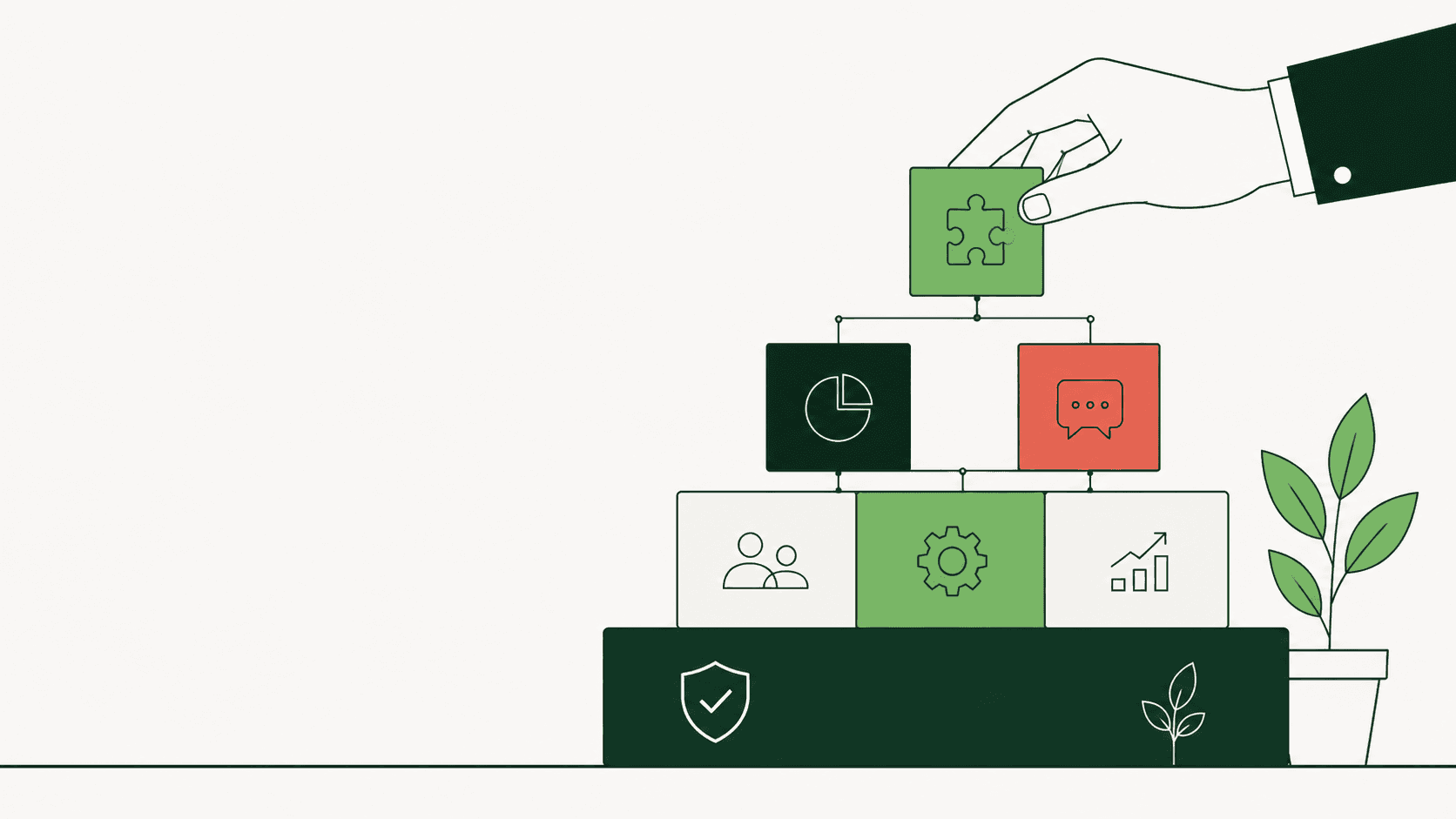
Think of software as building blocks. You do not happily keep stacking on a foundation that wobbles. First you get the bottom layer right, then you build the speed on top. That is the rule of thumb worth keeping: do not connect new software to a foundation that is off.
Foundation first, speed later.
What that looks like in practice
Take a restaurant with three locations. Bookings run through one tool, the till through another, guest details sit half in an email program and half in someone's head. Every Monday the figures get scraped together by hand. It works, until you open a fourth location and the house of cards falls over.
Digital transformation here is not "buy a new system". It is the choice to put those separate parts on one foundation, so a booking, a bill and a returning guest come together on their own. After that, the time now spent retyping goes to the guest at the table. That is the real payoff: not the technology, but the room you get back. We saw this play out at Pillows Hotels, where consolidating six properties onto one foundation freed up more than 4,200 hours a year.
Where you start
Start small and concrete. Take one process that grates today and costs time daily, and map which systems and which data are involved. That almost always answers the question of whether your foundation is ready for the next step, or whether there is work to do there first.
Want a hand with that? Best Byte's AI scan shows where your foundation stands and where the first wins are. No sales call, no obligation.